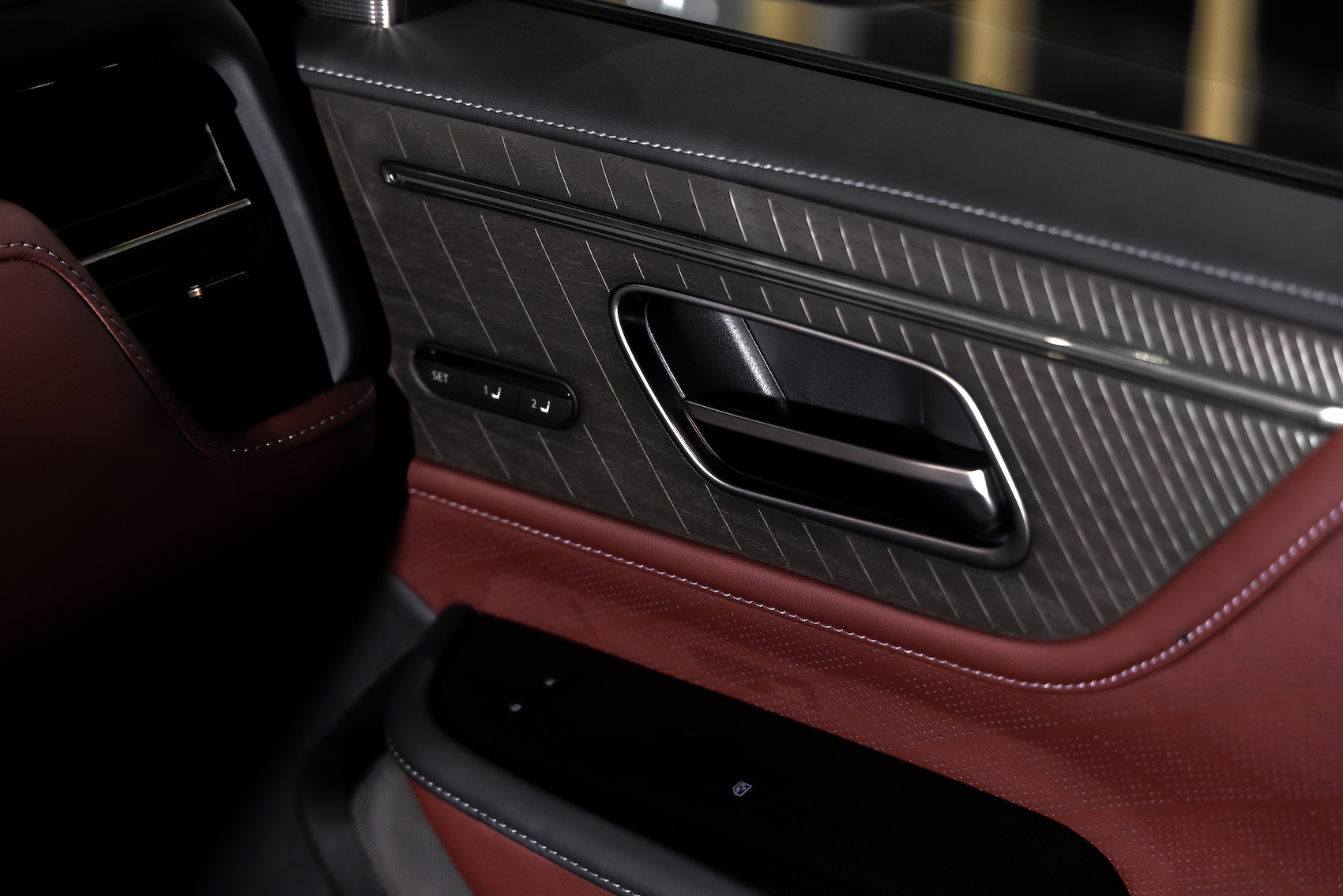
As the all-new INFINITI QX80 makes its debut at retailers across the Middle East, the design and engineering teams at INFINITI share how the traditional Japanese string instrument, the ‘Koto,’ has influenced the luxury SUV’s interior design. They also reveal how cutting-edge laser technology was integral in bringing this vision to life.
Shinji Hirosawa and Yuumi Aoyama from INFINITI’s advanced design department played a key role in shaping the color, materials, and finishes of the brand’s flagship vehicle.
In line with INFINITI’s design philosophy, Artistry in Motion, the team carefully selected premium materials and fine details to craft an open-pore woodgrain accent that enhances the remarkable atmosphere inside the QX80.
Koto-Inspired Wood Grain Design
The inspiration for the wood grain design in the QX80’s upper grades came from the Koto, a traditional Japanese string instrument. Resembling a long wooden board with strings, the Koto measures around 180 centimeters (71 inches) in length and is played by plucking its strings with fingerpicks.
Hirosawa and Aoyama sought to capture the expansive width and refined finish of the Koto in the QX80’s woodgrain accents.
The design team chose open-pore ash wood and applied a subtle blackened finish to create a delicate contrast with the ‘Graphite’ or ‘Sepia brown’ semi-aniline leather found in the SENSORY grade.
For the upper AUTOGRAPH grade, the designers introduced aluminum inlays that mimic the strings of a Koto, creating a bold geometric contrast against the ‘Burgundy’ or ‘Graphite’ leather.
Aoyama paid special attention to the spacing between the aluminum inlays, explaining, “To express the Koto’s sense of tension and its wide-spreading sound, we designed the metal inlays to widen and narrow as if they were creating rhythm and sound themselves.”
Exceptional Attention to Detail
Just as no two trees are alike, each woodgrain accent in the QX80 is unique. INFINITI’s design team explored a variety of wood types and cutting techniques before selecting ash wood for its optimal pattern and tactile qualities.
Achieving balance between the interior elements was crucial for creating a cohesive design. Hirosawa explained, “When you examine the woodgrain on its own, it’s like a Koto playing solo. The other elements—soft leather, stitching, lighting, and screens—act as the other instruments in a grand orchestra, coming together to create a harmonious visual experience.”
Before finalizing the design, the team reviewed over one hundred patterns and configurations, carefully selecting the final version based on visual appeal, tactile feel, and INFINITI’s stringent durability standards.
Precision Engineering with Laser Technology
Hidenori Miyazaki, the team leader of the interior design engineering group, was responsible for transforming the design team’s vision into reality. Over the course of a year, his team tested multiple samples and techniques to meet the exacting standards.
Miyazaki’s team employed state-of-the-art solid-state laser technology to make precise cuts in the open-pore ash wood, revealing the aluminum inlays underneath. This advanced laser technology, similar to what is used in medical and cosmetic surgeries, allows for perfectly straight cuts without damaging the wood grain or leaving marks.
Each wood trim piece in the AUTOGRAPH grade undergoes an hour-long laser process to ensure flawless precision. The team carefully calibrates the laser to account for the thickness and subtle curvature of each piece.
Additionally, achieving the perfect open-pore finish was a challenge, as the team needed to apply a thin, clear topcoat that would preserve the natural look and feel of the wood while ensuring durability. Miyazaki explained, “We had to apply just a thin layer of topcoat to maintain the natural feel of the open-pore wood while ensuring it matched the durability of traditional coatings, which are typically thicker and glossier.”
The all-new 2025 INFINITI QX80 is now available for purchase in the GCC, and will be available in Saudi Arabia next month.